
Getting Court Records in Utah
Know what you need first. Xchange locates eligible public District and Justice Court cases. The clerk at the Utah court holding the case handles inspection, plain copies, certified copies, and help with older files. Terminals offer a free route. Most Utah District Court locations and the State Law Library provide free public access to Xchange, and some Justice Courts do too. Call the local court before you count on a terminal or mail a request, since Justice Court access and submission methods vary around the state.
- Search Xchange for an eligible Utah District or Justice Court case, or use the separate Utah appellate docket for an appeal. MyCourtCase is for a party's own eligible case, not a public name search.
- Write down the Utah court, location, case number, party name, and the specific filing or date range you need. Case and citation numbers can repeat across Utah courts.
- Choose inspection, plain copies, a certified or exemplified copy, audio, or a transcript. The request channel and fee depend on the Utah product.
- Send the Utah statewide Request for Record form to the clerk who holds the file, or contact that clerk for counter, mail, email, fax, payment, and pickup instructions.
- Use the Utah county directory to find local court information, then confirm the exact venue with the case papers or court directory.
Which Utah Clerk Holds the File?
Utah has no single county clerk who keeps every kind of case. Each court has its own records office. The District Court clerk holds District Court civil and felony files. The Juvenile Court clerk handles Juvenile Court records. A Justice Court's own clerk keeps its traffic, infraction, ordinance, class B/C misdemeanor, and small-claims record. Business and Chancery Court and the appellate courts each have clerks as well. At certain contracted District Court locations, the elected county clerk serves as clerk of court, though that arrangement is location-specific. Name the right court before picking a contact. A Utah District Court case does not belong at a city Justice Court. A traffic citation should not go to the District Court clerk unless the citation itself names that court. The Utah Court Directory lists locations and contacts, and the Utah county directory is a helpful starting point, but confirm the venue on the case or citation rather than trusting a directory alone. The clerk structure follows the court and venue. A county name by itself may not point to the right records counter.
Types of Utah Court Records
Three different products hide behind the phrase "court record." The docket history from Xchange traces the sequence of entries in a Utah case. A complaint, motion, order, judgment, exhibit, or citation is a document inside the court file, and an image of it may or may not exist online. Certification is separate again: a certified copy carries the clerk's authentication. Utah also keeps hearing audio and written transcripts apart from the case record itself.
| Record | What It Provides | Where to Start |
|---|---|---|
| Case history | Utah index information and chronological case events or minutes. | Xchange for public District/Justice cases; Utah appellate search for appeals. |
| Filed paper or PDF | A specific Utah complaint, order, judgment, motion, or other case document. | Available Xchange Purchase link or the clerk holding the file. |
| Certified copy | A Utah clerk-authenticated copy of a specified court record. | Request from the official record-holding court. |
| Hearing audio | A recording of a Utah court proceeding, when retained and available. | District or Juvenile Court audio/reporting staff at the hearing location. |
| Transcript | Written transcription of Utah court proceedings. | Utah court reporter or transcription channel, separately from the case history. |
When a Utah Document Is Not Online
A Utah case can show up in Xchange with no document attached. Electronic filings in public Utah District Court cases since July 1, 2010 are described as available. The help text warns that coverage is phased and varies by case type. When a Purchase link appears, follow it. When it does not, the cause could be classification, document type, conversion, or simple technical availability. If the file is missing, contact the clerk at that court location. Older papers may sit in an archive, offsite storage, or microfilm, and no single statewide retrieval schedule covers them all. Give the clerk the court, case number, party, document name, and date. You can also file the Utah Request for Record form for a formal copy request. Keep in mind that a public case-history result can coexist with an attachment that is not classified for public viewing.
Inside a Utah Court Record
What is inside depends on the case and the document you ask for. An Xchange case history can show the court, case type, case number, parties, judge, and events. Some matters add an account summary. The filed record goes further, holding the actual claim, charge, motion, order, judgment, or exhibit. The case number and court location tie those layers together. One caution: the public index may not spell out every claim. It may not state the exact relief sought.
| Case number and type | Identifier and category assigned by the court; a Utah case number is not unique statewide. |
|---|---|
| Caption and parties | Utah case heading and party names with role codes such as PLA, DEF, PET, or RES. |
| Pleadings and filings | Utah complaints, petitions, answers, motions, citations, and other filed papers. |
| Orders and judgments | Utah court rulings and final decisions; obtain the filed order for exact terms and relief. |
| Case history | Utah proceedings and minute entries in date order; the extended history can contain more detail. |
| Account summary | Some Utah case histories show fines, fees, trust or revenue accounts, and amounts due or paid. |
| Exhibits | May have separate public-access limits or a court order controlling inspection. |
Utah's access rules can close off part of a case. A family history, judgment, or order may be public while the pleadings stay private. Ask the clerk for the specific document you need and whether certification is available.
A Utah Case History Is Not a Certified Copy
Three products, three levels of proof. An Xchange history lists events. A Purchase link opens one electronic filing for a fee. A certified record carries the clerk's seal. Neither the PDF nor a history printout counts as certified. When the receiving office requires authentication, request the copy directly from the court. A short code or balance only summarizes the case; the signed order states the court's actual terms. A public case shell can appear even while an attachment stays private or unavailable online. When in doubt, ask the clerk which record controls.
Utah Certified Copies and Fees
Utah Rule 4-202.08 sets separate charges for inspection, plain copies, certification, exemplification, and online documents. Check what format the receiving office requires. Order after that. Then give the clerk the case number, document name, and page count. The Utah Courts court record fee table lists the copy and certification charges in full.
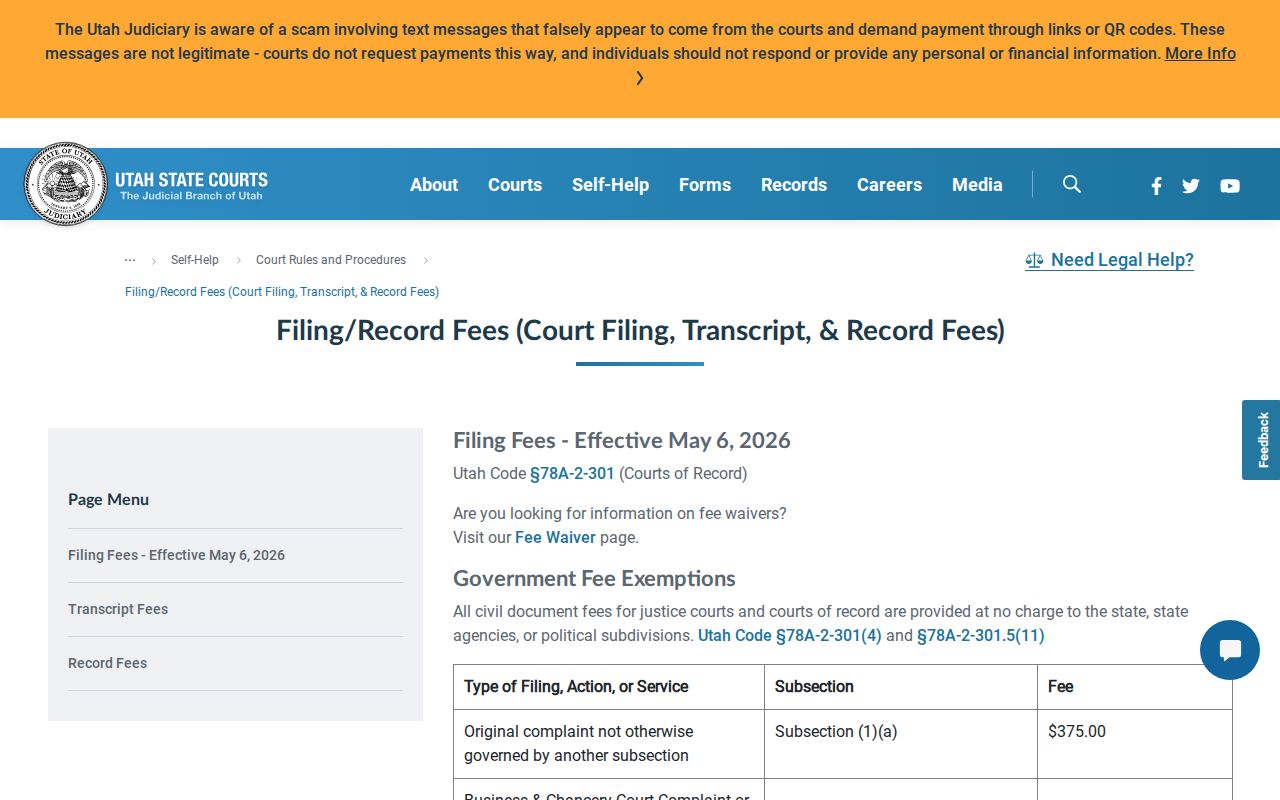
Treat the current Utah fee schedule as a starting amount only. Then ask the record-holding clerk about page count, payment, and delivery.
| Record or Service | Utah Rule Amount | Scope |
|---|---|---|
| Inspect a public record | No fee | Staff time may be charged in defined cases after the first 15 minutes. |
| Paper copy | $0.25 per sheet | Plain, uncertified copy. |
| Certified copy | $4 per document + $0.50 per page | Authentication by the record-holding court. |
| Exemplified copy | $6 per document + $0.50 per page | Special court authentication; confirm the requested format. |
| Email or fax copy | $5 for 10 pages or fewer + $0.50 per added page | Not used for a record already available in Xchange. |
| Xchange guest transaction | $10 for up to 10 searches | Remote public search, not an official copy. |
| Available Xchange document | $1 per document | Only when the case page shows a Purchase link. |
Utah charges only what postage actually costs to mail copies out. Staff time is another matter with a clear break. The first 15 minutes are free. Anything after that is billed in 15-minute increments. Payment, delivery, and how archived files get pulled are handled court by court. Ask the clerk directly. Rule 4-202.08 fixes the statewide fees.
Utah Court Audio and Transcripts
Hearing audio sits apart from the docket itself in Utah. You request it from the District or Juvenile Court location where the hearing took place, using the Utah court audio request form. The form wants the court, case number, hearing date, judge, and how you want it delivered. Delivery is either an MP3 or listening access. Expect up to 10 business days of processing once you pay. Under Rule 4-202.08, electronic audio or video runs $15 per half-day. An FTR Cloud recording is $10. Older versions of the form show different amounts. Confirm the current Utah fee with the court. A transcript is a separate product ordered through the reporter or transcript process.
Utah Record Requests and Response Times
Utah's Request for Record form asks you to pin down the essentials. Which Utah court holds the file? What document you want? Also whether you are asking for inspection, a copy, expedited handling, or nonpublic access. Add the case number, caption, document type, and date range. The completed form goes to the court holding the record. Each location has its own payment instructions. Most Utah courts answer within 10 business days. Qualifying expedited requests get a five-day window instead. Those are response deadlines, though. They are not guarantees the file will be in your hands by that date. If a written denial arrives, Rule 4-202.07 gives you 30 days to appeal it. Call the Utah court when a recent citation, an older file, or conflicting dates leave you unsure. The Utah Court Directory and county directory point to the right office.
Sealed Court Records in Utah
Utah starts from the opposite of secrecy. Rule 4-202.02 presumes court records are public. A rule, statute, or court order can make a case or document private, protected, safeguarded, or sealed. Juvenile, adoption, civil mental-health, expunged, and sealed matters fall outside an ordinary Xchange search. Sometimes a family history or an order stays public. The pleadings behind it stay private. GRAMA is the general government framework; court files answer to judicial rules and orders instead. A paid Xchange account will not open a sealed Utah record. Getting nonpublic material requires legal authority through the court's process. If access is denied, the appeal has to be in writing. The judiciary's current Rule 4-202.02 text spells out every Utah court-record category.
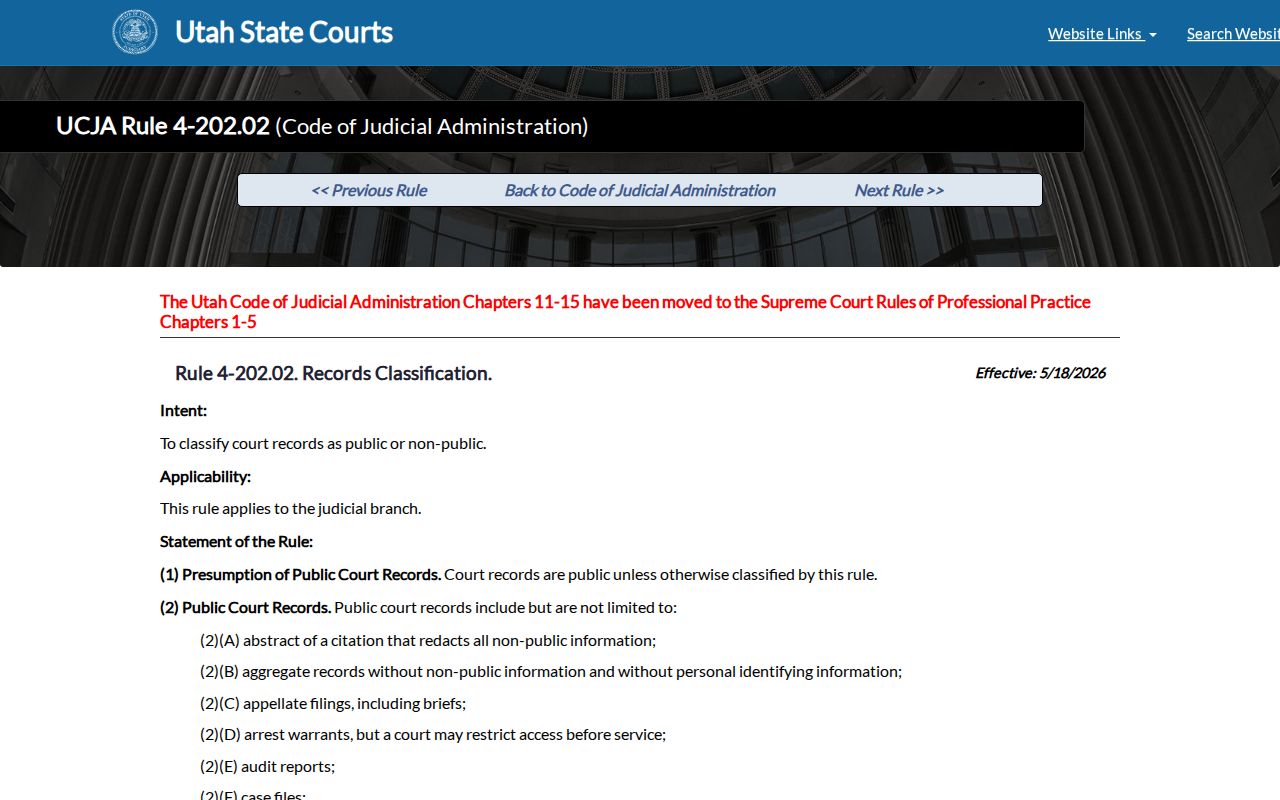
One Utah case file can mix public and restricted material. So read the rule alongside any order specific to that case before you assume what you can see.
Utah Court-Record Rules
Utah UCJA Rule 4-202.02 lists public, private, protected, safeguarded, and sealed classifications.
Utah UCJA Rule 4-202.03 governs who may access nonpublic record categories.
UCJA Rule 4-202.04 sets the request path and details for a claim of legal entitlement.
UCJA Rule 4-202.06 supplies response periods; Rule 4-202.07 covers appeals from denials.
Utah Court Requests Follow Judicial Rules
For court files, Utah's Request for Record process governs, not GRAMA alone. The public side is simple. Ask the Utah clerk holding the record, using the court form. Nonpublic material is different. That request needs a legal basis. It may require identity or authorization, and the form itself makes nothing public and waives no fee. If Utah denies you, use the written appeal channel within its deadline. Do not pay for more searches. Say exactly which order, judgment, or hearing record you want. For sealed, juvenile, adoption, or protected family material, figure out first who is allowed to ask. Keep in mind that a single document can be restricted. The Utah case history stays public.